Search This Blog

Showing posts with label Non Fiction. Show all posts

Wednesday, December 9, 2020

Odd is Art (Art)


by Ripley's Believe It Or Not! (Compiler)

Publisher : Ripley Publishing (May 8, 2018)

Hardcover, 144 pages

Amazon Listing 

One of my impulse COVID buys from the Ripley’s Sealife Museum in Myrtle Beach, SC. Since most of the country was blocked off, my wife and I’s had to settle for the resort town in the off-season - a place where I notice no one was wearing a mask and no police were handing out tickets. Still the lack of activity left me with some extra cash so I picked up a copy of this book and was happy with the purchase.

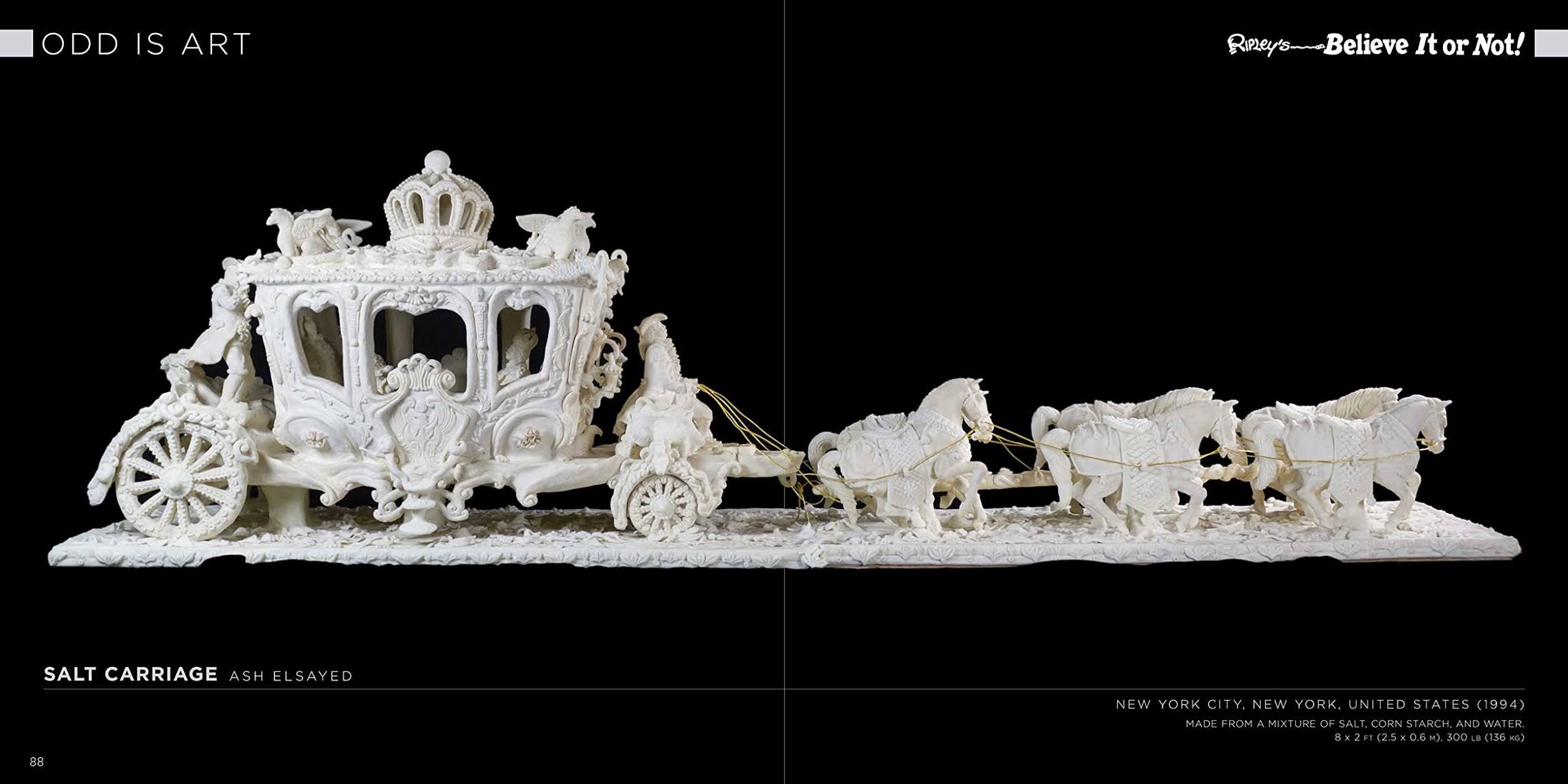
The book focuses on pieces of artwork crafted from unusual substances or from unusual artists. Each work is showcased large and accompanied by an informative caption. Scattered throughout are in-depth features that go into more detail about particular artists and their work. Each time I turned a page I found something weird and unique. From coffee bean portraits, to glued ash sculptures, to whole books printed on toilet paper. It’s all a fascinating read.

I would say more, but I think the pictures speak for themselves.


For more readings, try books by Rex Hurst


Wednesday, August 12, 2020

The Unabomber Manifesto: Industrial Society and its Future


by The Unabomber, Ted Kaczynski (Author)

Publisher: WingSpan Classics (November 20, 2008)

Softcover, 100 pages

Amazon Listing

“Leftists tend to hate anything that has an image of being strong, good and successful. They hate America, they hate Western civilization, they hate white males, they hate rationality. The reasons the leftists give for hating the West clearly do not correspond with their real motives. They SAY they hate the West becuase it is warlike, imperialistic, sexist, ethnocentric, and so forth, but where these same faults appear in socialist countries or in primitive cultures, the leftist finds excuses for them, or at best he GRUDGINGLY admits that they exist; whereas he ENTHUSIASTICALLY points out (and often greatly exaggerates) these faults where they appear in Western civilization. Thus it is clear that these faults are not the leftist’s real motive for hating America and the West because they are strong and successful.”

This is the manifesto of the infamous Unabomber who went on a twenty year bombing spree between 1978 - 1995. He offered to desist from terrorism if various periodicals published this document. They agreed and Kaczynski's, recognizing the style of writing, ratted him out.

Kacynski writes in the third person and under the pseudonym FC (Freedom club) to, presumably, deceived the FBI into believing the manifesto is part of a larger organization and not just one man in a shack pounding away on his manual typewriter.

Ted Kaszcynski, Unabomber

Now that modern industrialized man has, by sheer routine, dealt with the basics of survival - food, water, shelter - he had become a lesser creature, perverted from his natural purpose. To that end he becomes wrapped up in the power process of modern industrial society- which is A) Identify goal, b) Make effort, C) Achieve goal. This process takes up most of our time, which we also supplement with surrogate activities.

The surrogate activities are one which are set up merely for the sake of having a goal to work towards. These give the person a sense of achievement without actually getting something substantive from the exercise of effort. This is often mostly seen in people’s hobbies, people obsessed with video games, or any sort of collection of non-essential goods.

Freedom is thus naturally suppressed by any industrialized system, since said system needs everyone involved to play their part as a cog. The only freedoms left untouched are the ones which don't matter. Religion, speech, entertainment types don't really matter as long as everyone goes to work the next day.

In the struggle between technology and freedom, technology will always win because we quickly become dependent on that new technology. Freedom will always be taken away under the guise of altruistic means. Ie. for child protections, social justice, national security, etc.. Thus it is impossible to balance technology against the individual. And the answer is to stop trying and dismantle (or escape from) said society.

Unabomber as a child. 

This is an individualistic call rather than a plan of action for a movement. He is stating his beliefs in form, but seems to have little delusions that his actions will have much of an effect on the greater society. As for what he wanted, as the author himself points out, societies cannot be planned but evolve naturally like species. As such, he states the only escape from the freedom crushing weight of any industrial country is to retreat into a naturalistic state.

For more readings, try books by Rex Hurst.


Saturday, August 1, 2020

Death Squad: The Anthropology of State Terror (History)


by Jeffrey A. Sluka (Editor)

Publisher: University of Pennsylvania Press (October 7, 1999)

Softcover, 264 pages

Amazon Listing

"In 1983, one year after the socialist electoral victory, the assassination of Basque radical nationalists began under the anagram of a new paramilitary organization that called itself GAL, or Antiterrorist Liberation Group. From 1983  to 1985, the new paramilitary squad claimed the assassinations of twenty five Basque people. Most of them were Basque refugees, active or retired members of the radical nationalist guerilla organization, ETA, who were living across the frontier in the French Basque Country".

This is an academic book, so it is written in such a way as to bore and exclude the average reader, so be warned. By academic, I mean they assume a certain level of knowledge is already possessed on the subject by the reader and that the reader is also willing to read above a twelfth grade level - which most people aren’t. So you’ve been warned twice.

While I found the individual chapters of the book to be interesting, the reader has to wade through forty some pages of an indulgent and idiotic introduction. Where the editor discusses the use of state-terror, but somehow never mentions its use in communist countries. Instead the author sucks the cock of Noam Chomsky and places all of the blame on Western Civilization in general and the USA in specific.


The introduction then discusses the use of anthropologist as activist to achieve "social justice" and point out wrongs in the world, stating that the world of anthropology needs to be "decolonized" - without explaining what that means. Then it justifies screwing the results to affect social change which invalidates most of the work everyone has done in the next several chapters. In my view, skip the introduction and dive into the meat of the matter.

The rest of the book however focuses on the meat of the matter without the interference of the editor. Each chapter discusses a different use of state terror in the Basque territories of post-Franco Spain; the Punjab and Kashmir regions of India; Argentina; Guatemala; Northern Ireland; The East Timor region within Indonesia; and against the Muslim separatist movements in the Philippians.

The variety of tactics are fascinating. Some operate openly, others “disappear” dissenters in the middle of the night. Many use “unofficial” paramilitary groups to do their dirty work, so that the respective governments can maintain plausible deniability while destroying their political enemies. The firsthand accounts and background material is first rate here, as is the research documentation. These chapters are what makes the book worthwhile. The introduction and conclusion can easily be excised.

 For more readings, try books by Rex Hurst.

Monday, October 28, 2019

Notes on Nationalism (Psychology) (Non Fiction)

By George Orwell  

Publisher: Penguin Random House (2018)

Softcover, 48 pages.

Amazon Listing 


“By ‘nationalism’ I mean first of all the habit of assuming that human beings can be classified like insects and that whole blocks of millions or tens of millions can be confidently labeled as ‘good’ or ‘bad’. But secondly - and this is much more important - I mean the habit of identifying oneself with a single nation or other unit, placing it beyond good and evil and recognizing no other duties than that of advancing its interests. Nationalism is not to be confused with patriotism. Both words are usually used in so vague a way that any definition is liable to be challenged, but one must draw a distinction between them, since two different and even opposing ideas are involved. By patriotism I mean devotion to a particular place and a particular way of life, which one believes to be the best in the world but has no wish to force upon other people. Patriotism is of its nature defensive, both militarily and culturally. Nationalism, on the other hand, is inseparable from the desire for power. The abiding purpose of every nationalist is to secure more power and more prestige, not for himself but for the nation or other unit in which he has chosen to sink his own individuality.”  

This is a collection of three essays by George Orwell written in 1945 and published originally in the magazines: Polemic, Contemporary Jewish Record, and Tribune. All of them are additionally collected, along with a host of others, in Orwell’s Collected Essays. The three essays, “Notes on Nationalism”, “Antisemitism in Britain” and “The Sporting Spirit”, have a similar theme.  Each is an analysis of the phenomenon called nationalism.
For the above selection, you can see how Orwell divides nationalism and separates it from patriotism, but he also discusses an aspect of nationalism which I find fascinating and relevant to  American society today. That of negative-nationalism, where a person can have a purely negative attitude towards a society (usually the one they live in) with no positive feelings towards any other culture or country. While slightly different, this attitude is just as destructive as pro-nationalist attitude as a person’s main motivation. The negative-nationalist just wants to destroy anything to do with a society, to erase and condemn it completely. Often this is the prime motivation of various Communist\Socialist parties worming their way into positions of power. 


In the second essay, “Antisemitism in Britain”, Orwell discusses how anti-Jewish sentiment has not dissipated in Britain, but due to the Nazi atrocities it isn’t discussed anymore. Many people secretly still dislike the Jews, but would never openly admit it, making “stamping it out” (Orwell’s words) completely impossible if it hidden. 

The last article is rather lighthearted and demonstrates the tribal nature that people take to one’s sports team, and how often that team is much more important to people than the politicians about them. He points out people often treat their chosen political party with the same rah-rah-rah mentality that they do their football team. It’s not they're winning. It's we’re winning. 

For more readings, try books by Rex Hurst. 

Wednesday, October 23, 2019

The Eighth Tower: On Ultraterrestials and the Superspectrum (Psychology) (Non-Fiction)

by John Keel  

Publisher: Anomalist Books (December 31, 2013)

Softcover, 266 pages

Amazon Listing 


“In a real sense, all are one with this infinite energy field. It is not part of us. We are a trivial part of it. Energies on the lower frequencies would sometimes be responsive to rites and prayers. Man’s own mind, being part of the greater mind, could unconsciously manipulate some of these energies and form a pseudo-reality populated with spirits and demons. As Emanuel Swedenborg and other great thinkers discovered, we can even program these entities ourselves and bestow them with identities. Like Dr. Lilly’s experimental subjects, we create the supernatural world. It’s a part of us. The ghosts of our dead are an offshoot of the beliefs of the living. The devil is the byproduct of the evil that is in all of us.” 

This book is primarily made up of material originally collected for The Mothman Prophecies and if you haven’t read that book yet then do so before you pick up this one. It is better focused and touches on many of the same topics. John Keel is one of the most interesting researchers on paranormal occurrences since Charles Fort. 

From ancient religious manifestations, to faerie appearances, to UFO encounters, Keel ties them all together claiming they are exact same phenomena. The nature of the experience has changed, because it is a reflection of how humanity has changed. In the old days we would assume anything strange was connected to one’s own religion (Saul on the way of Damascus), but later on as sci-fi films really started to catch on then the odd encounters, lights in the sky, mysterious entities became creatures from other worlds.

He goes on to show that for every Saul on the road to Damascus who successfully changed history through religion, there are at least one hundred (or more) failures - all claiming to have been inspired by divine visions or encounters. He suggests the motivations of these entities (if they actually have one) are on par with the Trickster Gods of old. 

Ultimately his thesis is that these phenomena are a normal condition of the planet and reflect the state of the human race. That something has happened to the people encountered (whether it be aliens or Gods) but not what they actually remember. The encountees have been brainwashed, hypnotized, or reprogrammed to have a completely false experience. The purpose is unclear, but that there is an intelligence behind it all seems in little doubt. But what that intelligence is and its ultimate goal (again, if there is one) is anyone’s guess. The Eighth Tower is in fact the planet Earth (or a dimensional aspect of the planet) reacting to us. 
Original Cover of the novel

Things start to spin off the rails when Keel tries his hand at science. Using it to describe local phenomenon and how things act in relation to UFO experience, from audio and visual blips, to odd magnetization, to high levels of gamma radiation. There are many “studies have shown” or “polls indicate” or “many scientists believe” statements without any citing of sources. His credibility is further weakened by propping up various writers (such as Erich Von Donniken, Chariots of the Gods) and theories which were popular back in the day (this book was originally written in the 1970s) but have since been discredited over and over again.

If he had simply discussed his ideas without veering far past his technical competency then it would be a different story, but he had to make an attempt for his ideas to seem “real” to skeptics who wouldn’t believe him no matter what.
For more readings, try books by Rex Hurst. 

Thursday, September 6, 2018

Tetris: The Games People Play (Non Fiction) (Graphic Novel)

by Box Brown

Publisher: First Second (October 11, 2016)

Softcover, 256 pages

The history of everyone's favorite mindlessly additive game. Tetris! The game that's harder than Siberia. A game I used to play so much that I would see little floating blocks in my sleep. A female friend of mine was so addicted that she once played it for sixteen hours straight. Eventually she had to go cold turkey and get rid of her copy, otherwise she would probably still be sliding blocks together.

I had heard that there was a kerfuffle about rights when it first emerged, but I was in ignorance of the full drama behind the scenes and the political struggle that framed it all. It almost seems to be a comedy of errors, culminating in a huge battle in an international court. This story demonstrates fully the differences between a free market and the illiteracy and evil often present in the communist/socialist state. The fact that one of the negotiators was in danger of being imprisoned, possibly executed, for not getting the right result from the court case shows the evil mindset of the leftist agenda.
Box Brown frames the story as part of the classic tradition of mankind. That  the creation of games is part of the fundamental nature of humans. And that the games we play is a reflection of society and the human mind. In the old days, they played physical games to prepare for a life of physical labor. Now the electronic ones prepare us for the online world we are increasingly spend more of our lives in.

As usual, Box Brown’s minimalistic style parlays expertly into the subject manner. It focuses everyone’s attention on the bigger picture developing and makes for a riveting read. Well worth the time to read this book, especially anyone who has wasted hours of their life fitting the boxes into place.
For more readings, try books by Rex Hurst. 

Friday, August 24, 2018

The Doomsters Monolithic Pocket Alphabet (Graphic Novel)

By Theo Prasidis & Maarten Donders

Publisher: Image Comics (2017)

Hardcover, 64 pages


Here’s an odd little book I picked up at random from a $3.00 bin at my old comic shop. I had no expectations for this tome, apart from it being half art, half prose, and cheap. That lack of care was blessing for this review, as I no longer get a cheap thrill attacking other people’s work for the sake of it.
This “pocket alphabet” (or primer, as they called it back when I was young) are the ABCs of Doom Metal, which Wikipedia describes as “an extreme subgenre of heavy metal music that typically uses slower tempos, low-tuned guitars and a much "thicker" or "heavier" sound than other metal genres. Both the music and the lyrics intend to evoke a sense of despair, dread, and impending doom.” It is not a form of metal I’ve listened to, but I was a huge fan of their primary influence namely Black Sabbath (especially their first two albums). There are also various stylistic subgenres within this subgenre that don’t bear going into.

This book itself is well illustrated, each punctuating the letter on the opposite page as well as can be, but none of them caused me to stop and stare or marvel at how finely crafted it was. I glimpsed, saw it was done well, and moved on. Overall, it took me about fifteen minutes to get through the book.

As to the content, it seemed like a guide on how to be a wanna-be rebel and Doom Metal musician. Or more like, the ways one needs to conform to fit into the lifestyle of Doom Metal. Thus it’s just another way to be a conformist. I’m not sure how much of this is to taken literally. It does have a certain tongue-in-cheek vibe to it, but it is what it is- a curiosity about a subgenre of music. There are also certain references to specific people whom I assume are part of the Doom Metal scene, that I couldn’t be bothered to look up.
For more readings, try books by Rex Hurst. 


Tuesday, February 27, 2018

Stolen Valor: How the Vietnam Generation was Robbed of its Heroes and its History (History)

By B. G. Burkett & Glenna Whitley

Publisher: Verity Pr Inc. (September 1, 1998)

Hardcover 692 pages 

 
       “I saw this media distortion first hand. During an NVA attack of a nearby village, several South Vietnamese civilians suffered burns when the enemy torched their homes. The injured civilians were brought into our dispensary for medical treatment. Two reporters appeared at the main gate to do a story on how the Americans had ‘accidently napalmed’ the civilians. The village had not been napalmed. There had been no air strike. But the reporters had decided in advance what the story was. They wrote that the story had been napalmed.”
This powerful book describes the systematic stigmatization of the Vietnam veteran by the leftist anti-war movement with ties to communist elements and a lazy press intent on pushing an agenda rather than uncovering the truth. The term “fake news” has come into fashion lately and is bandied about by both the left and right- that is the manipulation of facts to push a political or social agenda. Little did we realize, as this book demonstrates, that the phenomenon of fake news has been going on in the mainstream media for as long as most of us has been alive.
For decades, various groups have been pushing the image of the Vietnam vet as a deranged loner, crippled with severe emotional trauma, unable to readjust back into the society that sent them into hell. However, as this book demonstrates over and over again, this is not the truth. Often these individuals who make claims of being involved in atrocities in Vietnam to reporters, or who show up at veteran’s events in old military gear, stinking of alcohol, are fakers. People who had never served in the military, were kicked out, or who never served in a combat zone. While many of them have mental issues, those conditions existed well before any military service.
The author of the book, while attempting to raise funding for a Vietnam memorial in Texas, kept running into obstacles with these fakes and the media portrayal of the Vet. Often one fed into the other. Reporters would ignore those who were adjusted and flocked to the deranged. Then the author began to look into the actual military history of the men who told the most outlandish stories and, almost universally, found that they were grossly exaggerating their experiences or were making them up completely.
Author B. G. Burkett

They had been allowed to get away with this for decades because the media were too lazy to check on these faker’s stories. Often they just reported whatever stumbled out of the “vets” mouth as absolute fact. When presented with evidence that they had been deceived, the media personality either would ignore it or became defensive and attacked whoever told them the truth. Learning that he always needed to have documentation, the author began systematically exposing phonies through their military records. The documentation in this book is fairly exhaustive, even if his stories of military frauds isn’t.
While every war has spawned its fakers, traditionally they have always revolved around fraudulent claims of valor in combat or fraud for veterans benefits. But it was the singular case of the Vietnam veteran that brought out the new type that of the PTSD faker, or the wounded vet fraud. One who would blame the war for why they couldn’t fit in with society. At first this was a mere trickle, but it quickly became a flood after the 1983 hit film First Blood and the introduction of its hero, John Rambo. After this, the victim hero became all the rage and the media was awash with mentally ill people describing false atrocity after atrocity and blaming “the war” or “the government” for their paranoid schizophrenia.
As we all know, PTSD is a real condition. It has been described in various terms throughout all history. The very first description of it comes from ancient Egypt. The Civil War named it Soldier’s Heart. World War I called it shell shock. Now we have a more clinical term, but, as any psychologist will tell you, it is a condition that is treatable and one from which 99% of soldiers recover. The fakers will nearly always claim it though, for attention, for benefits fraud, or to cover their other mental illnesses.
As these fakers made for a better story, the media (often without checking the faker’s stories). This then led to the reinforcement of the Vietnam Vet as psychotic time bomb, and attracted more loonies who wanted attention. This culminated in the CBS documentary The Wall Within by military wash-out Dan Rather. This film featured five “vets” that were unable to adjust back into American society after being forced to commit heinous rapes and murders of civilians by the U.S. Government. Several claimed to be special forces, or at least heavily involved in a combat arena. The author of this book filed various Freedom of Information Act requests and discovered that none of them had been deployed into combat zones in Vietnam. Several had never been in the military, others were nowhere near the fighting, a few had been enlisted after the conflict was over. Whether this was incompetence by the media, willful blindness, or a deliberate distortion is up for debate. However, no one can claim that it was fine journalism.
One of the most egregious examples of Stolen Valor Frank Dux, fake marine and fake "ninja" warrior. 

He continues to discuss the PTSD incidents, because he believes that it is used to push political agendas, the VA financial agenda (always need more money), the financial status of malingerers and fakers who can blame the failures of their entire lives on “the war”. He demonstrates here that while PTSD is a real thing, its effects should lessen over time, not increase. But if a person is receiving $2,500 a month from the government, tax free, because of PTSD related illnesses, where is the incentive to improve? If anything there is a negative incentive, it’s as if the government wants vets to be disabled… or at least pretend to.
Next to PTSD, the biggest fake claims comes from those who claim to have been infected with Agent Orange. The herbicide has been accused of causing everything from cancer to premature baldness, but no studies have linked it to anything except a skin rash if the dermis is exposed to it. The actual herbicide is a colorless liquid which causes leaves to shrivel up and die (not totally destroy the plant) whose purpose was to expose enemy troops hiding in the jungle. The trees would regrow their leaves within a week. It was called Orange, because the barrels containing it had an orange stripe down the side. So any stories from people claiming to be vets stating that they were covered in an orange mist is bogus.
Overall, it is difficult to contest that with the sheer number of fakers he uncovers, many of them picked up because their “incredible” stories are lauded in the media, there is a problem in the US. Whether it be sloppy journalism (as we are now all aware, the meticulous journalist is the rarity) or a ignorance by people how how to file a Freedom of Information Act request to obtain a person’s military record (DD-214).

Also included in the book are several appendices with the complete Department of Defense lists for those in Vietnam who have received the Medal of Honor, the Distinguished Service Cross, the Navy Cross, the Air Force Cross, and the names of all POWs in Vietnam who returned alive. Useful if you want to quickly check up on someone claiming to have won one of the highest military honors.

           For more readings, try books by Rex Hurst. 

Thursday, October 26, 2017

Bogie [Humphrey Bogart Graphic Novel]

by Claude Jean-Phillippe & Patrick Lesueur (Translated by Wendy Payton)

Publisher: Eclipse Books (November 1989)

Softcover 60 pages 


    Originally in written in French, this graphic biography, masquerading as an autobiography, has Humphrey DeForest (Yes, that’s his middle name.) Bogart as the narrator filling us in on the key events of his life. This book was one of series of graphic novels the authors did on old Hollywood stars. There are additional ones covering the life of the Marx Brothers, Errol Flynn, and Charlie Chaplin- though this is the only one reprinted in English. 

    The art is excellent, photo-realistic, culled from old publicity stills and candid photos. The coloring and shading gives a real gritty feel to Bogart and his permanent five o’clock shadow. It covers his upscale beginnings in the best neighborhood in Manhattan, to his early days as a bit player on the stage, to being the backup guy for George Raft, Paul Muni, and Jimmy Cagney, to his eventual rise to fame and cinematic immortality.
    While not the most exhaustive biography into Bogart's life (how could it be? It’s only 56 pages.), it covers the parts the casual reader would be interested in. It delves into some interesting detail on his four marriages, his incessant drinking, and his big break. Apparently he only got the lead in The Maltese Falcon because George Raft had little confidence in the new director John Huston. Who, of course, went on to direct some of the greatest films of all time. There are lots of fascinating tidbits like that in this book. 

    It was published by Eclipse Comics in 1989. Eclipse was one of the first direct marketing comic publishers which sprung up in 1977, after the new distribution system was set in place. It then crashed in the same direct market bust in the mid nineties- when oversaturation of material and a general decline in art and writing caused many people (including myself) to quit collecting the medium.  
    Their demise was unfortunate because they had consistently produced excellent creator owned material. Alan Moore and Neil Gaiman did Miracleman through them, an astounding comic only know being re-released after decades in legal hell. They published a lot of high quality adaptations of Clive Barker books. And they pushed out one of my favorite comics Destroyer Duck by Steve Gerber, Jack Kirby, and Buzz Dixon. Which was a comic designed to bring in money for Gerber’s ongoing legal battle with Marvel Comics over the rights to Howard the Duck. 

           For more readings, try books by Rex Hurst. 

Wednesday, October 25, 2017

The Gift: The Illustrated History of the Statue of Liberty (Graphic Novel)

by Henry Gibson & Alfredo P. Alcala

Publisher: Blackthorne Pub (May 1986)

Softcover 48 pages


    Here’s an old one from the 80s that I dug out while culling the crap from the back of my house. It was originally part of my classroom library when I was wasting my time being a middle school teacher. It was frowned upon by the pretentious administration to stack the shelves with material that kids might actually like, so I filled it overpriced educational material like this. Despite the cynical intro here, it is not a bad book. Perhaps it is a little too historically detailed for the middle school age range to take in (especially with the pack of imbeciles they’re churning out nowadays), but well researched and flawless in historical accuracy.

    It was published to coincide with the 100 year anniversary of the statue’s erection on Liberty Island. The story is often presented as the French just showed up at our door one day with a huge statue for us, as if it were a colossal surprise gift. It was actually brought over in various sections. The arm and torch was presented at the Philadelphia World's Fair in 1876 and the head at the (modeled after architect Frédéric Auguste Bartholdi’s mother- the body was that of his wife) in Paris several years later.
Frédéric Auguste Bartholdi

    The amount of planning that went into the statue was incredible. It really was one of the most daring experiments in the world at that time. The main architect's dream was to create a statue to rival the ancient civilizations. So with typical Victorian zeal, he set about doing it. First he attempted to create one for the opening of the Suez canal in 1869, but was rejected. Then the French government, having changed from a constitutional monarchy to a full fledged republic, wanted to cement ties with the United States, and agreed to the plan. To the French, this was as much about advertising their greatness as a goodwill gesture. They had recently completed the Eiffel Tower and this was their next achievement.  There was some government funding, but it was mostly supported by bond drives, raffles, and lotteries. The details of the actual construction was fascinating.
The book was published by Blackthorne Publishing, one of the many smaller comic houses that popped up when the direct marketing boom revolutionized the distribution methods of the medium. Initially they focused on reprints of classic strips, like Dick Tracy and Little Nemo in Slumberland, and parody comics such as Hamster Vice, Legion Of Stupid Heroes, Pre-Teen Dirty-Gene Kung Fu Kangaroos, and Cold Blooded Chameleon Commandos (The last two were parodies of Teenage Mutant Ninja Turtles, which itself initially was a parody. So a parody of a parody. Is there a word for that?), along with a few action and educational titles- like the one here. Their marketing was interesting as they never planned to publish a series for longer than 6 issues and most titles were simple one-shots, thus sidestepping many a new publisher’s trap of trying to establish a universe immediately, only to have the whole damn thing crash and burn.
    The company found their distinction in publication of 3-D comics which was a growing fad at the time. They cornered the market on these titles and rose to become the fifth largest comic publisher in the United States. That is until they severely overpaid for the licensing rights to do a 3-D adaptation of the Michael Jackson video Moonwalker. This, combined with their audience’s overwhelming lack of interest in the pedophile singer, bankrupted the company.
The author playing the head of the Illinois Nazi's in The Blues Brothers
    The author is none other than Henry Gibson of acting fame, a fact that only registered to me while glancing at the back of the book 10 years after purchasing it. Some may forget who this is, but he was a regular on the horribly dated Laugh-In (only good now for cringe laughs), the head of the Illinois Nazis in The Blues Brothers, and as Thurston Howell in the underrated flick Magnolia.  If you haven’t seen the last one, forget the book and go watch it immediatly. How he got into writing this book is unknown. I could not find any information anywhere and now that everyone involved is dead, it’s a mystery for the ages. C’est la vie!

           For more readings, try books by Rex Hurst. 
 

Wednesday, September 20, 2017

Turmoil in the Toybox (Humor) (Non Fiction)

by Phil Phillips

Publisher: Starburst Publishers; 3rd Printing edition (September 1990)

Softcover 191 pages


    “After extensive research Christian Life Research  and other experts have concluded that Dungeons and Dragons is not a game. Instead they claim that it is a teaching on demonology, witchcraft, voodoo, murder, rape, blasphemy, suicide, assassination, insanity, sex perversion, homosexuality, prostitution, Satan worship, gambling, Jungian psychology, barbarism, cannibalism, sadism, desecration, demon summoning, necromantics, and divination.”
    Looks like I’ve been playing a different game.
    An unintentionally hysterical book on the Occult terrors lurking in the toy boxes of American children. This was originally written in the 80s and revolves around most of the toy lines I grew up playing. And while I did become a Satanist, I doubt it was because I once picked up a Cabbage Patch Kid.
    Make no mistake, this is not really a full sized book. Ostensibly it is 191 pages, but seventeen of those are the gallery filled with pictures of toys which you already know how to visualize, ten of those are footnotes, and the font size is extra large. I will get something out of the way, to the author's credit he doesn’t claim the problems with the toy industry is due to a Satanic cabal as did many of his brethren. He is more focused on occult influence from humanist and eastern religions, but his worries are exaggerated to a ridiculous degree. 
The face of evil
    Pastor Phil Phillips (No to be confused with the singer of the same name, the one who gave us “Sea of Love”) was an evangelical missionary. That is one who roams around in revival tents and so forth, with no permanent flock to call his own. In order to make an impact, give himself some distinction, he decided to “bravely” go after the toy industry (not any specific company mind you- don’t want to get sued) for inserting occultism into their daily lives. Currently he’s running a non-profit in Texas, called God Loves Kids.
    The author has a shaky idea of what should be considered occult. He never fully explains it, either because he doesn’t know, or perhaps it was more effective as an ill-defined catch-all term for non-Christian. Or should I say non-evangelical fundamentalist Christian, which is its own thing. This was written during a time when there was a big anti-Catholic push in the fundamentalist community. The pope was the antichrist and spreading the word of Satan. Anything not part of foot-washing baptist dogma was suspect, which is why you have doom peddlers like the author lumping Buddhism, Judaism, Wicca, Satanism, and Hinduism into the same evil lump. I suppose, though, from his perspective it is.
    The author does make some good points about parenting. Rather, he parrots some good points. Much of the useful information here is cited from other sources, which I will give him credit for. He has done research and does not plagiarize. Though much of what he has to say is common sense. Pay attention to what your kids are watching on television, limit the amount they watch each day, make sure they are eating healthy. Howver, as most of the toy lines he mentions here Rainbow Bright, He-Man, Crystar, etc are dead franchises, which tends to lessen the impact of his message. 
 
Glamor shots of author Phil Phillips
    He saves special venom for Masters of the Universe and Dungeons and Dragons. Apart from the supposed occult angle, was use of cartoons to push toys. This was a hot button issue at the time, and He-Man was the first cartoon and toy line to be produced simultaneously. After their massive success, nearly all  new toys and cartoon followed the same pattern. He rails against this as a brainwashing of children to be mindless consumer drones, and so on. The occult angle is specious. Skeletor had a staff with a ram’s skull on it, a sign of evil. This offended our author even though the character is clearly the series main villain. He-Man is the most powerful man in the universe, when that should be "Je-Sus".
    He then goes on to bash various other toys and cartoon. He does state that while the toy may appear to be harmless, they in conjunction with the cartoon may call up occult practices. My Little Pony is evil because, “the unicorn is a symbol of the antichrist.” In this case he’s getting his occultism mixed up. He writes, “the New Age, also known as the Golden Age, is referred to as the Age of Aquarius or the Eon of Horus.” Now this perhaps a little esoteric but New Age has nothing to do with the Eon of Horus. The latter is part of the philosophy of the Thelemites, the religion promoted by Aleister Crowley and associates. Lumping them together as if they are the same thing demonstrates a lack of understanding on the author. While there may be some similarities, there is a significant enough difference in my mind.  Care Bears, G.I.Joe, E.T., Star Wars toys and so on are attacked next. Basically anything you enjoyed as a child was evil in some manner and that's why you're such a horrible person.
    The purpose behind this occult influence is prompt the kid to act out occult practices with the toys, while the child is under the impression that they are just playing. The toy acting as an occult avatar or surrogate for the helpless child. Then the child will supplant the toy and perform the evil rituals or rites or what have you themselves (the specifics are unclear), allowing them to be seduced into the homosexual lifestyle, abortion parties, and general evil. 
Seducers of the innocent.
    The condemnation of Dungeons and Dragons (which my parents briefly fell for) centers around the same hoary old chestnuts anyone who played tabletop RPGs in the 80s will be familiar with. Most of it is typified by the quote at the beginning of this review. RPGs are Satanic, they teach occult practices and evil magic, they cause the loss of a personal ego into a paper homunculus, etc. The author only mentions D&D by name, but I assume his ire extends to all other RPGs as well, though he more than likely doesn’t know what they are. 
       I’ve heard all of this before. It sent me back to a frustrating time when I had to patiently explain to my parents how bullshit it all is. They didn’t believe me, but I eventually wore them down until they shut up about it.  "The book says", "The book says" was their mantra, as if the printed word couldn't be a lie. Guess what, it can and does!
    In general this book takes a lot of material gathered by other groups on toys, films, and cartoons in the 80s and puts a paranoid fundamentalist spin on it. As I wrote above, the fact that most of these cartoons and toys are now defunct, and that those who played with them are all adults, shines a bright light on how crazy these suppositions are.It's fun for all the wrong reasons.
           For more readings, try books by Rex Hurst.